


Æionics
Act with Clarity
Breathe. Discern. Engage.

Æionics is a research-informed ecology for navigating complexity, uncertainty, and relational responsibility. It helps people and groups pause just enough to notice what is happening, clarify what matters, and choose a proportionate next step.
This work is grounded in education, wellbeing, reflective practice, relational ontology, and human-system readiness. It is designed for moments where the answer is not obvious, the stakes are shared, and engagement requires care.

When things are complex, clarity is not a possession.
It is a process.
In everyday life, organisations, education, policy, technology, and relationships, people are often asked to respond before they have had time to understand what kind of situation they are in.
Æionics begins differently.
It asks:
What is the capacity here?
What is the orientation?
What trajectory is forming?
What relational field are we inside?
What response is proportionate now?
Rather than pushing people toward performance, certainty, or over-confident action, Æionics offers a gentle but rigorous way of returning to the conditions that make engagement possible.


What Æionics Does
Æionics supports people to:
Pause before reacting.
Discern what is actually being asked of them.
Notice when complexity is too much, too fast, or too unclear.
Clarify the conditions needed for meaningful engagement.
Move from overwhelm toward proportionate action.
Reflect without collapsing into self-blame or abstraction.
Act with care in relation to others, systems, and shared futures.
At its simplest, Æionics begins with one conscious breath.
At its fullest, it becomes an ecology of reflection, imagination, ethical action, and collective becoming.


The Public Tier 1 Process
Breath → Clarity → Context → Permission → Choice
Æionics can be engaged simply.
Breath
Pause long enough to return to the body.
Clarity
Notice what is present, pressing, or unclear.
Context
Ask what conditions are shaping the situation.
Permission
Consider what kind of engagement is possible, safe, and proportionate.
Choice
Take one next step with care.
This process is not about finding the perfect answer. It is about becoming more able to respond well.

Research-Informed, Practice-Oriented
Æionics has emerged from doctoral research, educational practice, reflective frameworks, wellbeing theory, relational ontology, and applied workshop design.
It draws from traditions including:
Reflective and transformative learning
Educational philosophy
Critical pedagogy
Agential realism
Bio-ecological wellbeing theory
Human-system readiness
Relational ethics
Practice-based design
Complexity-oriented facilitation
The aim is not to simplify complexity into slogans. The aim is to make complexity more inhabitable.
Core Ecology Snapshot
The Æionics ecology moves through three primary functions:
Containment
Creating enough steadiness to remain with what is happening.
Calibration
Sensing the conditions, limits, possibilities, and tensions present.
Proportionate Engagement
Choosing an action that fits the situation, the person, the group, and the wider field.
These functions are supported by a recursive structure:
One Conscious Breath → Conditions of Engagement → ReflæXion → Prismætics → Imaginætion → ÆXionEach movement returns to the breath as an entry, exit, and reset.

Who This Is For
Æionics is for people, groups, and organisations working at the edge of complexity.
It may be useful for:
Educators and schools
Universities and researchers
Students and learning communities
Organisations navigating change
Wellbeing and inclusion initiatives
Technology and innovation teams
Human-system interface projects
Community organisations
Policy and standards bodies
Reflective practitioners
People seeking a more relational way to act well
Featured Invitation
Start with one conscious breath.
Before exploring the full ecology, begin here.
Place one hand somewhere steady.
Take one conscious breath.
Notice what is asking for attention.
Do not rush to solve it.
Let the first act be orientation.
Start the 3-minute process
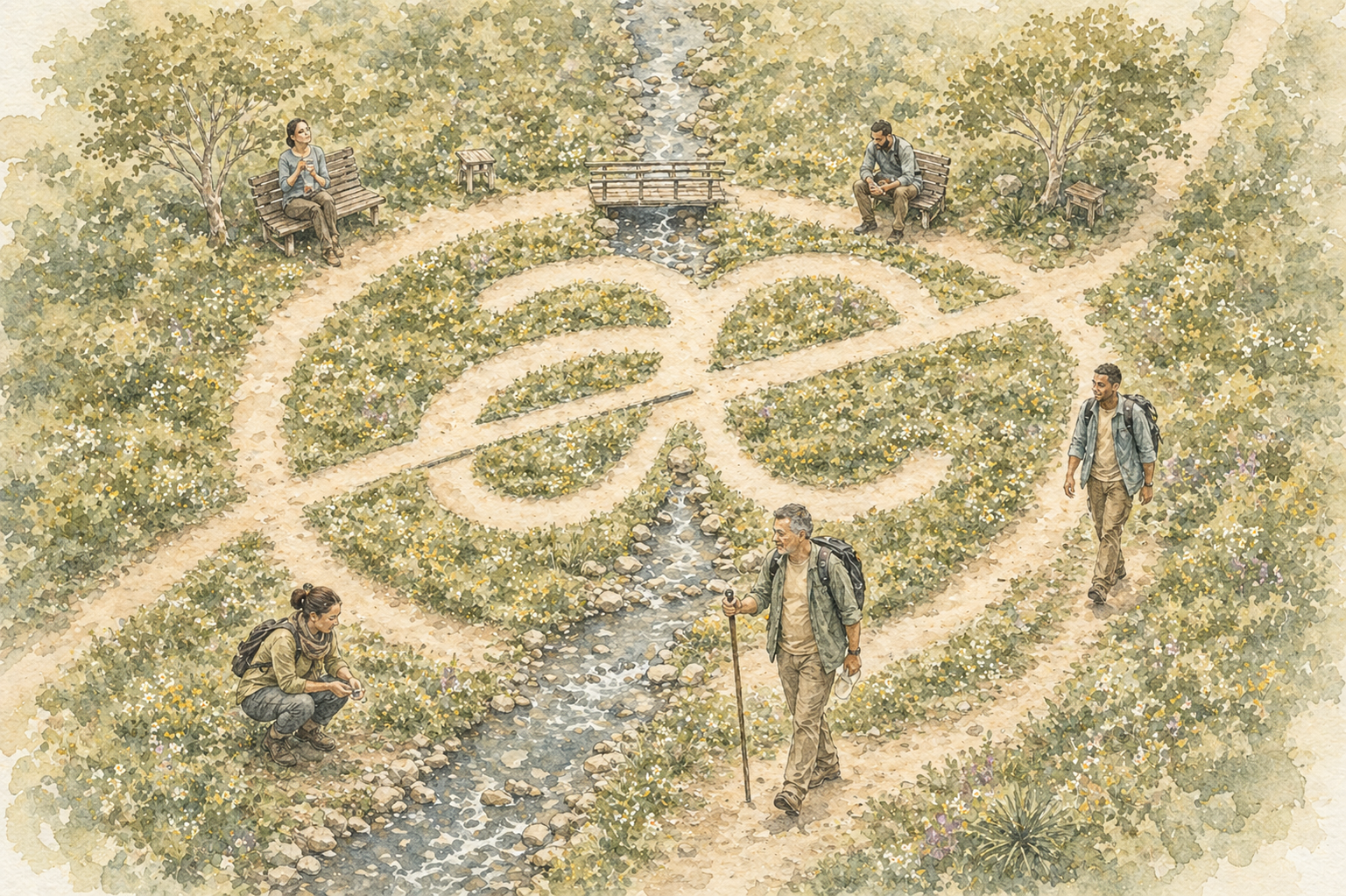
Æionics is not a method for controlling complexity.
It is a way of becoming more response-able within it.
To engage well is not always to do more.
Sometimes it is to pause.
Sometimes it is to listen.
Sometimes it is to clarify.
Sometimes it is to step back.
Sometimes it is to act.
Æionics helps discern the difference.